
Every meter of core that ends up in a tray started out inside a core barrel. It’s the piece of equipment that sits at the very bottom of the drill string during diamond drilling, and it’s the reason a solid, undisturbed cylinder of rock makes it to the surface at all instead of being ground into fragments. Understanding how it works explains a lot about why core recovery varies from hole to hole — and why the handoff from barrel to tray matters so much.
What Is a Core Barrel?
A core barrel is a cylindrical tool attached to the bottom of the drill string that cuts around the outer edge of a rock formation rather than grinding through it, leaving the center section intact so it can be brought to surface as a solid sample. That’s the fundamental difference between core drilling and conventional drilling: standard bits destroy everything they touch, while a core barrel preserves an undisturbed record of the rock it passes through.
Most modern exploration drilling uses a wireline core barrel, built as a double-tube system: an outer tube that rotates with the drill string and does the cutting work, and an inner tube that stays stationary relative to the rock, protecting the core from rotational stress and drilling fluid as it’s captured.
The Components That Make It Work
A core barrel is a precisely engineered assembly, and each part has a specific job in getting an intact sample to surface:
- Outer tube: the component that actually pushes and rotates the core bit. It’s built from thicker material than a standard drill rod because it absorbs the majority of the drilling stress.
- Locking coupling: connects the outer tube to the drill rod and holds the inner tube’s head assembly in place during drilling, keeping the inner tube turning in sync with the outer tube.
- Adaptor coupling and landing ring: work together to give the inner tube assembly a stable landing area when it’s lowered or pumped into position, absorbing the impact as it comes to rest.
- Inner tube stabilizer: keeps the inner tube centered and steady inside the bit, so it’s properly aligned to receive the core as drilling advances.
- Inner tube assembly: houses the core catcher and core lifter mechanisms that grip the sample and prevent it from slipping or vibrating loose as the barrel is retrieved.
None of these parts work in isolation — a misaligned inner tube stabilizer or a worn landing ring can affect core quality just as much as a dull bit, which is why experienced drillers treat the whole barrel assembly as a system rather than a single tool.
How the Core Barrel Affects Core Recovery
Core recovery — the percentage of the drilled interval actually retrieved as usable core — depends heavily on how well the core barrel is performing, not just on rock conditions. A well-maintained, properly aligned barrel reduces vibration and mechanical stress on the sample as it’s cut and captured, which directly improves recovery in fractured or structurally complex ground.
In a typical wireline diamond drilling cycle, the drill string rotates continuously as the barrel advances through a run of several meters. Once that run is complete, the drill string is disengaged and a wireline retrieval system pulls the inner tube — and the core inside it — back to surface, without needing to remove the entire drill string from the hole. That efficiency is one of the main reasons wireline core barrels became the industry standard: faster round trips mean more meters drilled per shift, without sacrificing the quality of the sample recovered.
From Core Barrel to Core Tray
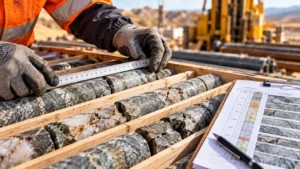
Once the inner tube reaches surface, the core barrel’s job is essentially done — but the core’s journey is just beginning. The sample has to be extracted from the tube, washed, oriented, and placed into a tray in the exact sequence it came out of the ground, preserving the depth record that the entire drilling process was designed to protect.
This is the point where equipment choice shifts from the drill rig to the core shed. Coreplast’s core trays, built in standard HQ, NQ, and PQ formats to match common core barrel sizes, give exploration teams a reliable, labeled place to receive core straight from the barrel — carrying forward the same attention to detail that went into recovering it in the first place.
Frequently Asked Questions
What is the main difference between a core barrel and a regular drill bit?
A regular drill bit grinds or breaks apart everything it contacts. A core barrel cuts only around the outer edge of the rock, leaving the center section intact so it can be recovered as a solid, undisturbed core sample.
Why is core recovery sometimes lower even with a good core barrel?
Core recovery is affected by more than just equipment condition — fractured, friable, or highly weathered rock can break apart inside the barrel regardless of how well-maintained it is. That said, a misaligned or worn barrel can make recovery worse in ground that would otherwise perform reasonably well.
Why is diamond drilling almost always paired with a wireline core barrel?
A wireline system allows the inner tube — and the core inside it — to be retrieved without pulling the entire drill string out of the hole. In diamond drilling programs where holes can run hundreds or thousands of meters deep, that efficiency significantly speeds up the drilling cycle without compromising sample quality.