
A geotechnical drilling operation does not end when the material is extracted from the subsurface. The recovered core samples contain information about the ground, and to make use of this information later, they must be properly identified and kept in good condition.
What happens to these samples once they reach the surface? In this article, we’ll look at how they are organized, what data is recorded, and why a rock core sample must be properly preserved
What is the purpose of geotechnical drilling?
Drilling allows for the collection of material from different depths to determine the composition of the ground. By examining the recovered core samples, specialists can identify changes between different sections and record characteristics that cannot be directly observed from the surface.
Among the data that can be examined are:
- Rock type: helps identify the materials found at different depths.
- Condition of the material: It is determined whether the rock is sound, altered, weathered, or exhibits other conditions.
- Fractures: Their presence, distribution, and characteristics are examined.
- Recovery: A comparison is made of how much material was obtained relative to the drilled section.
- Depth: This helps correlate each characteristic with the exact point where it was found.
What happens to a sample once it is retrieved from the ground?
Once the core is recovered, a phase begins in which organization is just as important as the care taken with the material.
Recovery and Organization
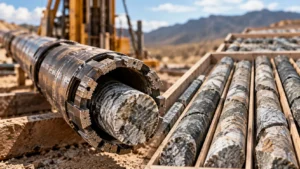
The material is arranged in the order in which it was extracted. Depths and references must be clear from the outset, so that each section can be linked to the corresponding point in the borehole.
This step may seem simple, but poor organization from the start can lead to problems during subsequent logging. For this reason, boxes and labels are part of standard core handling procedures.
Recording Characteristics
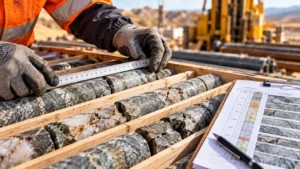
Once the core is organized, its characteristics are reviewed, and the corresponding data is recorded. The record may include the rock type, visible changes, fractures, recovery rate, and other aspects that help describe the conditions encountered.
It is also common to photograph the material before proceeding with other tasks. This provides a visual record associated with the sample and its depth.
Preparation for Storage
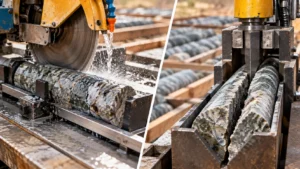
After documentation, the rock core sample must be properly identified and stored. In some processes, the core is divided so that one part is sent for analysis and another is retained as a physical reference.
This reference sample is especially useful when it is necessary to consult the sample again at a later time.
What data should each record contain?
It is not enough to simply store a box full of core samples. Each sample requires information that helps identify it and link it to the corresponding section of the borehole.
- Identification using the code or reference number assigned to the sample.
- Depth, to indicate which section of the borehole it comes from.
- Recovery rate, to record how much material was recovered during drilling.
- Rock characteristics, such as the type of material and its condition.
- Fractures and structures that can be observed in the core.
- Observations on any details that may be useful when reviewing that interval.
Recording this data in an organized manner makes it easier to consult the information later without having to reconstruct the entire process from the beginning.
Errors That Can Complicate Record-Keeping
During a drilling campaign, certain oversights can end up affecting the available information. Among the most common are:
- Mixing samples from different depths.
- Attaching the wrong label or losing it.
- Leaving data for a section incomplete.
- Handling core samples without sufficient care.
- Storing boxes without following an order.
- Failing to keep visual records of the samples.
Avoiding these problems depends largely on maintaining a clear routine from the moment the core leaves the drill until it is stored.
When Is a Sample Still Useful?
The work carried out during a geotechnical drilling operation can still be consulted long after the campaign has ended. Logs, photographs, and physical samples serve as references when it is necessary to review an area, compare information, or reanalyze specific intervals. For this reason, taking care of the core from the very beginning should not be viewed as a task separate from logging.
At Coreplast, we develop core sample trays designed to facilitate the organization, identification, and safekeeping of samples during exploration work.
Contact us and find the solution that best suits your project’s needs!
FAQs
What is geotechnical drilling?
Geotechnical drilling is a process used to obtain subsurface samples in order to determine the characteristics of the soil and evaluate its conditions for a project.
What is the purpose of a rock core sample?
A rock core sample allows for direct observation of the material recovered at different depths. Documenting it helps determine the characteristics of the terrain and preserve information for future reference.
What information is recorded in a drill core?
Data such as depth, material recovery, rock type and condition, the presence of fractures, and other characteristics observed during the sample examination can be recorded.
Why is it important to preserve core samples?
Because a properly identified and stored sample can be consulted again after fieldwork is completed. This helps verify information without relying solely on written records.