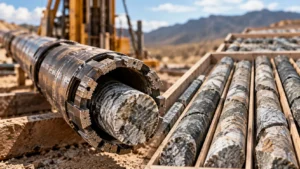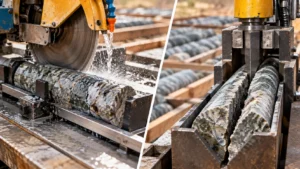

During drilling, each section of rock that reaches the surface provides information about what is happening underground. However, it is not enough to simply retrieve the material; it is also necessary to examine how much was obtained, how it is fragmented, and what portion retains the rock’s structure.
This is where two concepts that are often related come into play: core recovery and RQD. Although both are derived from drill cores, each provides different information about the rock mass.
What information does core recovery provide?
Recovery shows what proportion of the drilled section was recovered as core. For example, if 2 meters are drilled and 1.8 meters are recovered, the recovery rate is 90%.
This figure indicates how much material reached the surface, but by itself it does not indicate the condition of the rock. A section may have a high recovery rate and, at the same time, consist of several small fragments.
From Recovered Core to Rock Quality Designation
RQD stands for Rock Quality Designation and is used to estimate the quality of the rock mass based on the core samples obtained during drilling. In Spanish, it is also referred to as the rock quality designation.
Unlike total recovery, the RQD does not consider all recovered material. To calculate it, only fragments of sound, intact rock that are 10 cm or longer in length are taken into account.
Therefore, it is important to distinguish between these two concepts:
- Core recovery indicates how much material was obtained relative to the drilled length.
- RQD takes into account how much of that section consists of sound, intact pieces longer than 10 cm.
Thus, a core with good recovery will not necessarily have a high RQD if it contains many natural fractures.
How is the RQD calculated?
The RQD calculation is based on a specific section of the borehole. First, the recovered core samples are examined, and those that meet the established minimum length are identified.
Then, their lengths are added together, and the result is compared to the total length of the drilling run or interval being analyzed. For example, if a drilling run is 2 meters long and the core samples that meet the criteria total 1.2 meters, the RQD will be 60%. Such a value falls within the range considered average or fair quality in standard classifications.
Not All Core Breakages Are the Same
An important part of the review involves determining how the rock broke. Not all separations found in a core sample correspond to natural fractures in the rock.
Situations that may be encountered include:
- Natural fractures: These occurred in the rock mass before drilling.
- Drilling-induced fractures: These may occur as the drill bit advances.
- Handling damage: occurs when extracting, moving, or transporting the core.
- Rock alteration: some materials may undergo changes due to weathering or other natural processes.
What can affect the RQD result?
The value obtained does not depend solely on the rock. There are also conditions related to the drilling operation and sample handling that can affect the result.
Among the main factors are:
Rock type and structure
The composition and characteristics of the rock mass influence the quantity and size of the recovered fragments.
Natural fractures
Rock with many fractures can produce smaller pieces and lower the RQD.
Alteration or weathering
The condition of the rock can cause the material to be more weakened or fragmented.
Drilling technique
Poorly executed drilling can cause additional breakage and affect material recovery.
Core handling
Impacts or sudden movements during extraction and transport can break pieces that were originally intact.
Therefore, the way the core is recovered, recorded, and preserved also influences the quality of the information obtained.
What does a high or low RQD mean?
The RQD is expressed as a percentage between 0 and 100. Generally speaking, higher values indicate a greater proportion of sound, intact rock fragments measuring 10 cm or more within the analyzed section.
This classification helps interpret the result:
| RQD (%) | Rock Quality |
| 90 – 100 | Excellent |
| 75 – 90 | Good |
| 50 – 75 | Fair |
| 25 – 50 | Poor |
| 0 – 25 | Very poor |
Properly documenting the core makes all the difference
Once the material has been recovered, it is important to keep it organized and clearly identified. That way, if a sample needs to be reviewed later, it will be easier to determine which section it came from and what its characteristics were.
Core recovery indicates how much material was obtained during drilling, while the RQD helps determine what portion of that material consists of fragments of sound, intact rock measuring 10 cm or more. Reviewing both sets of data provides a clearer picture of the conditions encountered below the surface.
At Coreplast, we develop core sample trays designed to facilitate the organization, identification, and safekeeping of samples during exploration work.
Contact us and find the solution that best suits your project’s needs!
FAQs
What is the difference between core recovery and RQD?
Core recovery indicates how much material was obtained relative to the drilled section, while RQD takes into account the amount of sound, intact rock recovered in pieces 10 cm or larger.
What is core recovery?
Core recovery is the amount of rock obtained after drilling, compared to the total length of the drilled section. This data helps determine how much material was successfully extracted during drilling.
What is RQD?
RQD (Rock Quality Designation) is an indicator that helps determine the condition of a rock mass based on the recovered core samples. To calculate it, fragments of sound, intact rock measuring 10 cm or more are considered.