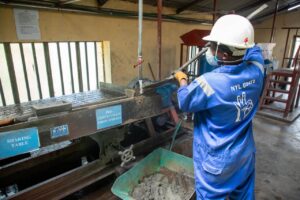

Diamond drilling gives geologists a solid core they can go back to years later. RC drilling does not. Reverse circulation produces rock chips, most of which are bagged, sent for assay and never seen again. What stays behind is a small portion of each interval and whatever the geologist wrote down at the rig. That is why chip trays matter: they are the only physical and visual record of an RC hole that survives the field season, and how they are filled, logged and stored directly affects the quality of the data built on them.
What Are Chip Trays?
A chip tray is a compartmented tray used to hold a small, representative portion of the chips from each sampled interval of an RC hole, laid out in depth order. Each compartment corresponds to one interval, so the geologist can see the whole hole at a glance and compare one interval with the next. Trays with 20 compartments are a common format, and the lids need to close properly, which means the compartments should not be overfilled.
Chip trays are not a substitute for the assay sample. In a typical RC program, the chips come up through the cyclone or splitter and are collected in calico bags and larger bulk bags. The calico bags go to the laboratory for assay, while the bulk bag is used to take a reference sample, a pXRF sample and a sieved chip sample. The chip tray holds the sieved portion that the geologist uses for logging and for the permanent visual record.
Why Chip Trays Matter More Than They Seem
Because RC drilling produces chips and not core, there is no intact sample to go back to if the log is wrong. Errors in RC logging pass silently into the database and tend to surface only at resource estimation, as diluted or inflated blocks that cannot be reconciled against the original material. By then the chips have been bagged, submitted and assayed.
Diamond core can sit in a core shed and be re-logged years later. RC chips usually leave the site. The chip tray and its photograph are therefore the geological record, and they deserve the same discipline that is normally applied to core.
Preparing RC Samples for the Chip Tray
How the chips are prepared before they go into the tray determines how useful the log will be:
- Wet sieve a representative portion of every interval. Check the dust and fines first, since clues to lithology and sulphide content lie in both the fines and the chips. A quick wet sieve takes less than a minute per interval and reveals grain size, colour and mineralogy that are hard to see in a dusty, dry tray.
- Wash and place the chips in the right compartment. Each interval goes into its own compartment, matched to the interval recorded by the driller.
- Do not overfill. A tray that does not close cleanly will spill or mix intervals during transport.
- Consider a second tray for fines. Some geologists fill a chip tray with the fine fraction while sieving. If it is filled to the top and gently compressed, a pXRF can analyse it cell by cell, either at the rig or later at the office.
Five Logging Habits That Protect Your Data
RC logging is only as reliable as the habits behind it. These five practices keep the chip tray record honest:
- Set the intervals before drilling starts. If the driller collects on 1 m intervals and the geologist logs on 2 m composites, geological boundaries will not line up with assay data from the first metre. Agree on intervals, write them on the trays and check alignment at every rod change.
- Wet sieve before logging. Logging from a clean, representative portion is more reliable than logging from a dusty tray.
- Log colour, grain size and mineralogy as separate fields. Combined free-text descriptions cannot be filtered across hundreds of intervals. Separate fields let the database sort, filter and flag anomalies.
- Photograph every chip tray with a colour reference card. The photograph is the permanent visual record once the chips have been bagged. A reference card keeps colours comparable across lighting conditions, geologists and seasons.
- Cross-check boundaries against the driller’s records. A geological contact that coincides with water loss or a drop in sample recovery may be a drilling artefact rather than a real contact. Flag it and investigate before it reaches the model.
Storing Chip Trays After Logging
Once logging and photography are complete, the trays become an archive. A few practical rules help them stay useful:
- Label clearly. Hole ID and depth range should be visible on the tray so it can be matched to the log and the photographs without guessing.
- Keep depth order. Store trays in sequence, so that anyone reviewing a hole can follow it from top to bottom.
- Protect from dust and moisture. Closed lids and dry storage keep chips from mixing, drying out unevenly or degrading.
- Keep the photographs and logs with the trays. Together they are the record that supports later re-interpretation, audit and competent person review.
Chip Trays and Core Trays in Mixed Programs
Many programs combine both methods. A hole may be pre-collared with RC through the upper section and finished with a diamond tail through the target, so a single hole can produce both chips and core. In that case the sample chain needs two kinds of trays: chip trays for the RC section and core trays for the diamond section.
For the diamond side of those programs, Coreplast manufactures core trays in non-toxic polypropylene, with drainage holes, measurement marks and stacking and nesting capability, so the core recovered below the RC section stays in order from the rig to long-term storage.
Whatever the drilling method, the principle is the same: the container that holds the sample first is the container that protects the geological record, so it should be chosen and handled with care.
Frequently Asked Questions
What is the difference between a chip tray and a core tray?
A chip tray holds small portions of RC chips, one compartment per sampled interval, and is mainly used for logging and as a visual record. A core tray holds the solid core recovered by diamond drilling, laid out in channels in depth order, and is used to store the actual sample for logging, cutting, transport and archiving.
How many metres of an RC hole does each chip tray compartment represent?
Each compartment represents one sampled interval, and the interval should match what the driller collects. Many programs use 1 m intervals, but what matters is that the driller and the geologist agree on the interval before drilling starts so that logs and assays line up.
Why should RC chip trays be photographed?
Once RC chips have been bagged for assay they usually leave the site and cannot be re-examined. A photograph of each tray, taken with a colour reference card, becomes a permanent visual record that supports re-interpretation, audit and review of the geological log.