
Most exploration programs end up using both reverse circulation (RC) drilling and diamond drilling, and the choice is usually framed around cost, speed and depth. But the two methods also produce very different physical samples, and that changes everything that happens at the rig and in the core shed: how the material is collected, how it is split, what can contaminate it, and where it is stored. Understanding those differences helps exploration teams plan handling procedures before the first hole is drilled, not after the first assay surprise.
Two Methods, Two Kinds of Sample
The fundamental difference is the sample itself. Diamond drilling cuts a solid cylinder of rock that is recovered intact in a core barrel. RC drilling uses a pneumatic hammer to break the rock into chips, which are carried to surface by compressed air through dual-wall drill rods.
That single difference explains most of the trade-offs. Core preserves structure, texture and orientation, which makes it the standard sample for geological and geotechnical logging. RC chips are usually faster and cheaper to obtain and work well for assay when they are dry and properly split, but they lose texture and structural information. In practice, many programs use RC for first-pass testing and infill drilling, and diamond drilling where structure, depth or resource-grade detail is needed.
How RC Samples Are Handled
RC sample handling happens at the rig, in real time, and it is a continuous process rather than a single event:
- Collection: the returning air and cuttings pass through a cyclone, which separates the rock chips from the air stream.
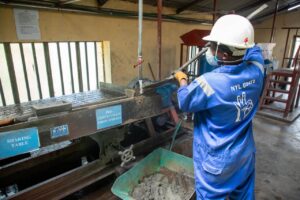
- Splitting: the chips are usually split per metre with a cone or riffle splitter, producing a laboratory sample of a few kilograms. The remaining material, the reject, is kept in bags or piles beside the hole.
- Logging: geologists log the chips from small samples kept in chip trays, which act as a quick visual record of each interval.
- Bagging and labeling: each bag has to be matched to the correct hole and depth interval, since a mix-up here cannot be corrected later.
Because the material is moving and being divided at the rig, RC sampling quality depends heavily on equipment condition and discipline during drilling.
How Diamond Core Is Handled
Diamond core handling is slower and more deliberate. The core is extracted from the inner tube and placed in order into trays, marked with depths, measured for recovery, photographed and logged. Where structure matters, the core is also marked with an orientation line so that structural geologists can measure the true orientation of veins, faults and bedding.
For assay, the core is usually cut lengthways with a diamond saw, or in some cases split mechanically. One half goes to the laboratory and the other half is kept for reference; in some programs a quarter is sent instead when more material has to be retained. Each sample receives a unique code that links it back to the hole and interval, and sample intervals are typically set around lithological contacts so that each sample represents a single geological unit.
Unlike RC chips, the core does not get consumed during sampling. The retained half stays in the tray, sometimes for years, as the physical record of the hole.
Sample Handling Compared
Seen side by side, the handling requirements of the two methods look quite different:
- Sample form: intact core (diamond) versus rock chips (RC).
- Where sampling happens: at the rig, as drilling advances (RC), versus after the core is recovered, at the core shed (diamond).
- Division method: cone or riffle splitter (RC) versus diamond saw or mechanical splitter (diamond).
- What is kept: reject bags and small chip tray samples (RC) versus the retained half-core in trays (diamond).
- Main handling risks: carryover, wet samples and biased splits (RC) versus inconsistent cutting and disordered core (diamond).
Where Things Go Wrong in Each Method
RC drilling
RC drilling reduces contact between the returning sample and the borehole wall, but it does not eliminate contamination. Damaged dual-wall rods, material left in the cyclone or splitter, dust and mixed-up bags can all affect results. Wet samples are another known weak point: below the water table, wet intervals can lose fine material, clog splitters and produce biased splits, so they should be recorded in the database and treated differently from dry intervals.
Contamination is especially important when drilling moves from a mineralized zone into a barren one, because even small amounts of residual material can change an assay. Cleaning the cyclone and splitter between rods and holes, and documenting spills and blockages, are basic precautions.
Diamond drilling
With diamond core, the main risks appear after drilling. Core can be broken or disordered while it is transferred from the inner tube, recovery can be low in broken or clay-rich ground, and inconsistent cutting or splitting biases the assay half relative to the retained half. Mislabeled or mixed-up core compartments are another common source of error.
QA/QC Applies to Both
Whatever the drilling method, the same quality control logic applies. Blanks check for contamination, certified reference materials check laboratory accuracy, and duplicates measure the precision of sampling and splitting. These controls are typically inserted at regular intervals, often making up around 10% of a sample batch, and they are most useful when planned in advance rather than added after a problem appears.
In RC programs, blanks placed after high-grade intervals are especially useful for detecting carryover. In diamond programs, duplicates help show whether the way the core is cut or split is introducing bias.
Handling Combined Programs
Many deeper holes are pre-collared with RC through the upper part and finished with a diamond tail through the target zone. That means a single hole can generate both chip samples and core, with two different handling routines. Teams that plan for this up front, with clear labeling conventions, consistent depth records and storage for both sample types, avoid a lot of confusion when the data is later compiled.
Where Core Trays Fit In
On the diamond side of a program, the core tray is the first and longest-lasting container the sample will ever have. It keeps the core in the correct depth order from the moment it leaves the inner tube, supports logging and photography, holds the retained half after sampling, and carries the core through transport and storage.
Coreplast’s core trays are made of non-toxic polypropylene with drainage holes, measurement marks, built-in handles and stacking and nesting capability, and are available in HQ and NQ formats across their Model 2 and Model 3 ranges, and in HQ, NQ and PQ formats in Model 1. For programs that combine RC and diamond drilling, that means the core side of the sample chain is protected by a tray designed to stay consistent from the rig to long-term storage.
Frequently Asked Questions
What is the main difference between RC drilling and diamond drilling for sample handling?
RC drilling produces rock chips that are collected through a cyclone and split at the rig, while diamond drilling produces solid core that is logged, cut and stored after it is recovered. RC handling is a continuous, fast process at the rig; diamond core handling is slower and focused on preserving order, depth and the retained half.
Can RC samples be used for resource estimation?
Yes, RC data is widely used in resource estimates when sampling and QA/QC are good. Concerns arise with wet samples, poor recovery or contamination, which is why those intervals are recorded and are often compared against diamond holes.
Why is it important to keep half of the diamond core after sampling?
The retained half is the permanent physical record of the hole. It allows geologists to verify results, re-sample intervals, carry out additional tests and revisit the geology years later, which is not possible with material that has been fully consumed by analysis.